
How Oracle Fusion Setup and Configuration Registry makes implementation knowledge reusable, machine-readable, and executable through AI agents.

Introduction
Enterprise application implementation has traditionally been a complex and resource-intensive process. It requires organizations to translate business requirements into application configurations, manage dependencies, execute setup activities, perform data loads, and validate results. These activities demand functional expertise, technical knowledge, and coordination across implementation teams.
For decades, implementation teams have relied on product documentation, functional consultants, configuration guides, and project-specific knowledge. Much of this knowledge must be interpreted and reconstructed across projects, particularly as enterprise applications evolve.
Oracle is addressing this challenge with the Oracle Fusion Setup and Configuration Registry (FSCR), announced at Oracle AI World on October 26, 2026. FSCR is a public Git repository that makes Oracle Fusion Cloud Applications setup and configuration machine-readable and executable by AI agents. It captures Oracle product expertise and best practices as reusable AI skills.
These skills enable AI agents to plan, execute, test, and validate setup and configuration activities. By making implementation knowledge available in an executable format, FSCR provides a foundation for reducing repetitive setup work and helping implementation teams focus more on business transformation and process redesign.
What Is Oracle Fusion Setup and Configuration Registry (FSCR)?
Oracle Fusion Setup and Configuration Registry is an open-source collection of AI skills, scripts, and reference workflows designed to support planning and configuration of Oracle Fusion Cloud Applications. Available through a public Git repository, FSCR provides machine-readable and executable setup and configuration knowledge.
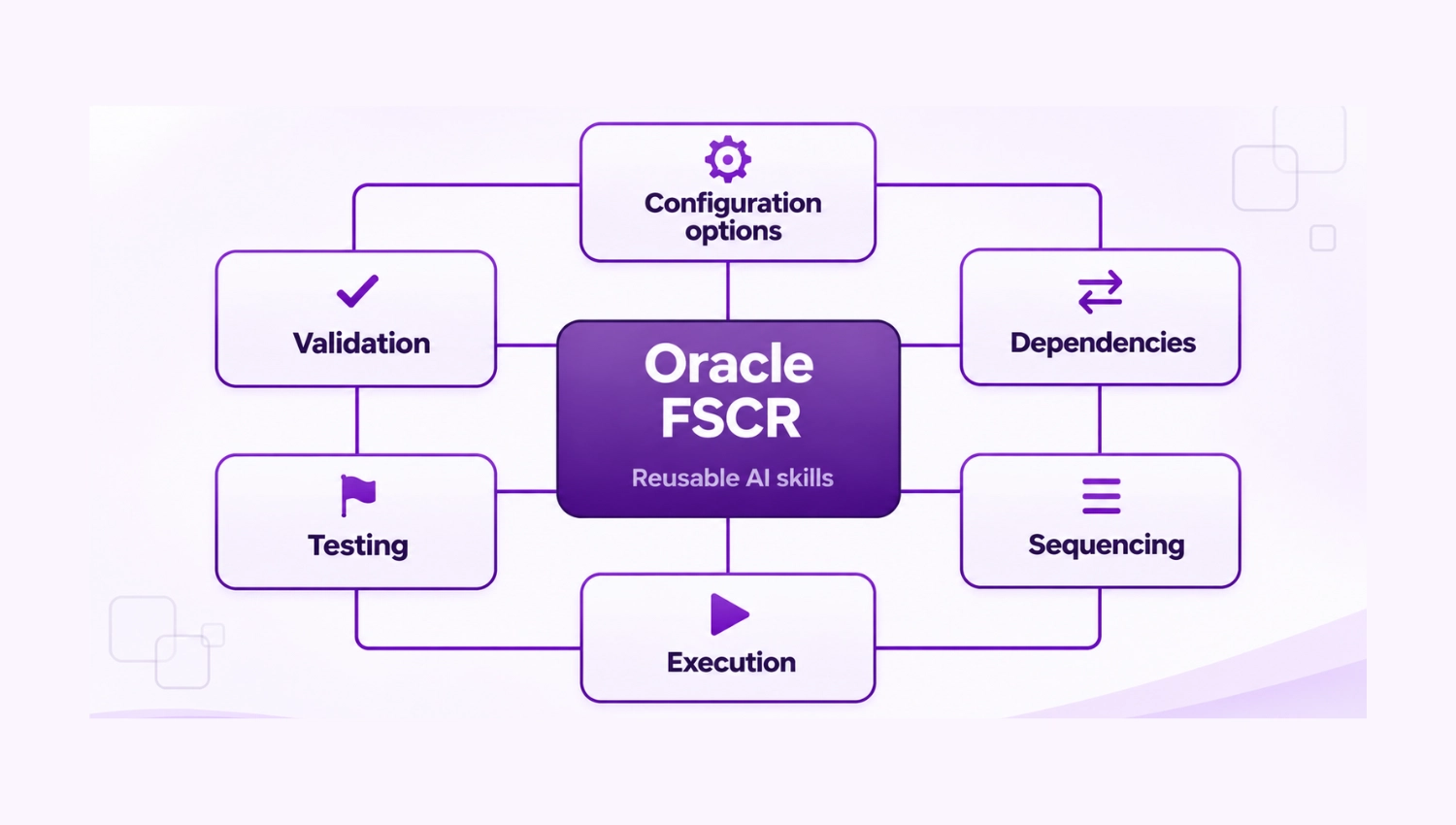
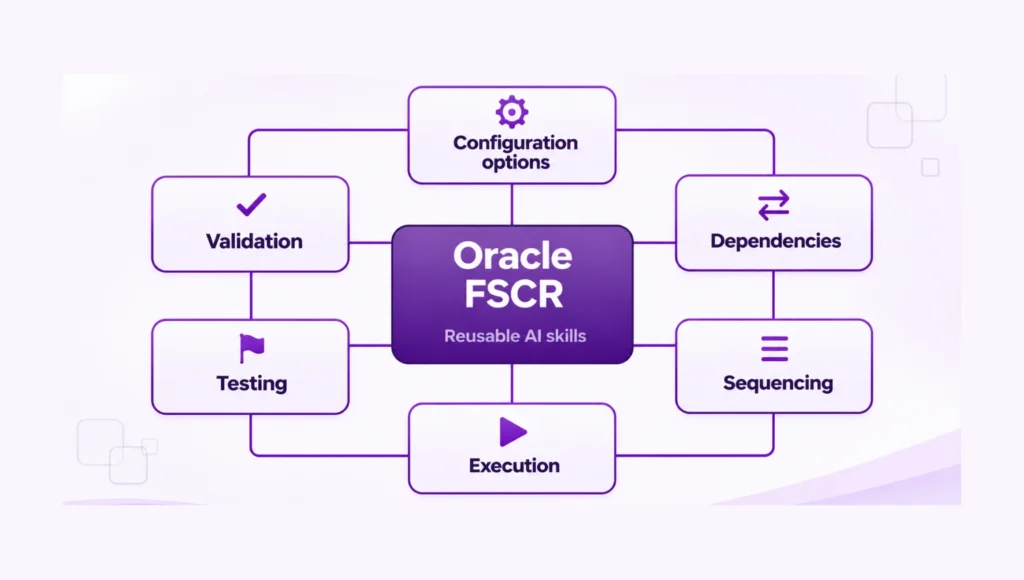
It captures Oracle product expertise and product-defined best practices in reusable AI skills covering:
Configuration options: | understanding available setup and configuration choices. |
Dependencies: | identifying relationships between configuration activities. |
Sequencing: | determining the appropriate order for implementation tasks. |
Execution: | supporting AI agents in performing setup and configuration activities. |
Testing: | supporting automated testing of configuration activities. |
Validation: | verifying configuration results before changes are approved. |
Using FSCR, AI assistants and coding agents can interpret business requirements, process documents, policies, spreadsheets, and existing configurations to generate implementation runbooks and perform supported implementation activities. Oracle maintains the repository alongside Oracle Fusion Applications.
An important distinction: FSCR is separately released sample and reference material, not a standalone Oracle Fusion Cloud product feature. It provides implementation resources for use with an appropriately authorized Oracle Fusion Cloud environment. |
How Does Oracle FSCR Work?
FSCR enables AI assistants and coding agents to translate implementation inputs into actionable setup and configuration activities. Business requirements, process documents, policies, spreadsheets, and existing configurations can be used to identify setup needs and generate structured implementation runbooks.
These runbooks organize implementation tasks, dependencies, and execution requirements. Agents can then plan configuration, execute supported setup activities and updates, and test and validate results. FSCR also supports activities such as approved data loads, setup imports and exports, configuration comparisons across environments, and investigation of data-load failures.
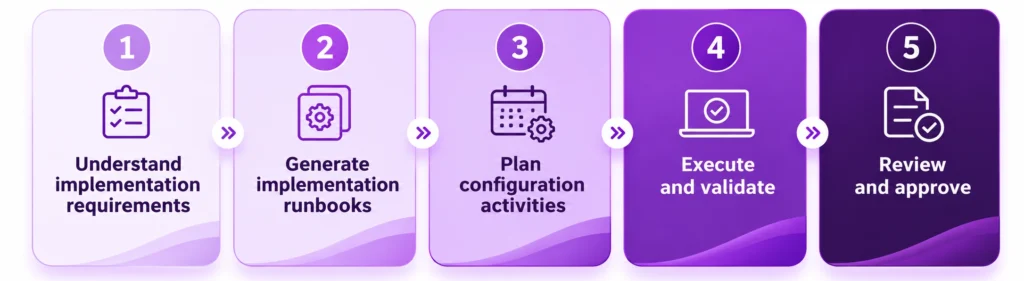
The process can be understood through five stages:
1
Understand implementation requirements: AI assistants interpret business requirements, process documents, policies, spreadsheets, and existing configurations to identify required setup activities.
2
Generate implementation runbooks: Requirements are translated into structured implementation tasks, including relevant activities and dependencies.
3
Plan configuration activities: AI agents use FSCR skills to identify configuration options, dependencies, and execution sequences.
4
Execute and validate: Agents perform supported setup activities, configuration updates, and approved data operations, then test and validate the results.
5
Review and approve: Implementation teams review generated plans, requests, and proposed changes before execution or deployment.
This approach combines Oracle product knowledge, AI-assisted planning, execution capabilities, and human review.
Key Capabilities of Oracle FSCR
01
Reusable AI skills based on Oracle product expertise
FSCR provides reusable AI skills that capture Oracle product expertise, setup definitions, and product-defined best practices. These skills help AI assistants and coding agents understand Oracle Fusion configuration requirements and apply relevant implementation knowledge.
02
Machine-readable configuration knowledge
FSCR makes Oracle Fusion setup and configuration knowledge machine-readable and executable. Its skills cover configuration options, dependencies, sequencing, execution, testing, and validation, helping agents use structured knowledge rather than relying exclusively on static documentation.
03
Implementation planning and runbook generation
AI assistants and coding agents can map requirements and spreadsheets to Fusion setup tasks, build dependency-aware plans, and generate implementation runbooks that organize activities and retain task progress and supporting information.
04
Setup and configuration execution
FSCR supports AI agents in planning and executing supported setup and configuration activities directly in Oracle Fusion Applications, helping reduce manual effort associated with repetitive implementation work.
05
Data loads and setup imports and exports
FSCR includes workflows that support approved data loads and setup imports and exports. Execution depends on the applicable workflow, environment access, and required permissions.
06
Configuration comparison and troubleshooting
FSCR supports comparing setup across environments and investigating data-load failures, helping teams examine configuration differences and troubleshoot implementation issues.
07
Project continuity and workspace management
FSCR includes a local implementation project workspace that helps preserve project state and artifacts across sessions. Project information, configuration exports, baselines, decisions, and implementation artifacts can be organized within the workspace.
Oracle AI Success Navigator: Bringing Specialized AI Agents into Implementation
Alongside FSCR, Oracle introduced Oracle AI Success Navigator, an agentic AI platform designed to help customers accelerate the implementation and modernization of Oracle Fusion Cloud Applications. Built on FSCR, it combines specialized AI agents, Oracle implementation expertise, and guided learning.
FSCR provides the underlying setup and configuration knowledge through reusable AI skills, while Oracle AI Success Navigator brings specialized agents and guided capabilities into the implementation process.
Oracle introduced six specialized AI agents:

Discovery Agent
Helps customers analyze existing environments and identify implementation scope, process gaps, risks, and modernization opportunities.
Design Agent
Helps translate business processes into specific application designs for review and approval.
Configuration Agent
Helps develop application prototypes by building Oracle Fusion configurations based on customer-specific designs and business processes, using setup knowledge and best practices available through FSCR.
Testing Agent
Helps accelerate testing by building customer use cases and identifying steps to align testing with application configurations.
Integration Agent
Helps define integration scope and architecture for existing systems and develops code required to build integrations.
Innovation Agent
Identifies and prioritizes opportunities to increase application and AI adoption based on potential business outcomes.
Together, these agents extend AI capabilities across discovery, design, configuration, testing, integration, and innovation. Oracle AI Success Navigator is designed to support customers moving from on-premises or third-party applications, starting new Oracle Fusion Cloud implementations, or adopting the latest Oracle AI capabilities.
How FSCR Changes the Oracle Fusion Implementation Approach
FSCR introduces a different approach to managing foundational setup and configuration activities. In traditional implementations, teams spend considerable time interpreting requirements, researching configuration options, identifying dependencies, preparing documentation, executing setup activities, and validating results. With FSCR, AI assistants and coding agents can use reusable Oracle skills to support these activities.
Traditional approach | FSCR-enabled approach |
Configuration knowledge reconstructed across projects | Reusable Oracle AI skills provide product expertise and best practices |
Manual interpretation of implementation inputs | AI assistants map requirements to setup tasks |
Dependencies identified through manual analysis | Dependency-aware plans and runbooks |
Repetitive setup activities performed manually | AI agents execute supported setup and configuration activities |
Configuration validation handled as separate activities | AI agents support automated testing and validation |
Project progress maintained across separate documents | Project workspace retains state and implementation artifacts |
This approach does not eliminate the need for implementation expertise. Instead, it changes how that expertise can be applied. As AI agents take on more structured and repetitive activities, consultants, architects, and implementation specialists can focus more on business process transformation, enterprise architecture, governance, and complex business requirements.
What FSCR Means for Oracle Fusion Customers and Implementation Partners
For organizations implementing or expanding Oracle Fusion Cloud Applications, FSCR provides opportunities to streamline setup and configuration through reusable product knowledge and AI-enabled workflows.
- Reduce manual effort associated with repetitive setup and configuration.
- Support more structured implementation planning through dependency-aware runbooks.
- Reuse Oracle product expertise and configuration best practices.
- Support automated testing and validation.
- Improve visibility into configuration dependencies and execution sequences.
- Support configuration comparisons and data-load troubleshooting.
- Improve continuity through a project workspace that retains implementation artifacts.
For implementation partners, FSCR creates an opportunity to build on Oracle’s open foundation with their own methodologies, accelerators, automations, and industry-specific solutions. This allows partners to develop differentiated implementation capabilities while applying their expertise to customer-specific requirements, complex business processes, and industry transformation.
The Role of AI in the Next Generation of Enterprise Implementations
FSCR reflects a broader transition in enterprise technology: AI is moving beyond assisting users with individual tasks to participating in structured business and technology workflows. Within enterprise implementation, AI assistants and coding agents can interpret requirements, generate implementation runbooks, plan configuration activities, execute supported operations, and validate results.
Oracle AI Success Navigator extends this approach through specialized agents that support discovery, design, configuration, testing, integration, and innovation. Successful adoption still requires organizations to consider environment access, user permissions, configuration governance, testing, validation, and appropriate human approval.
The next generation of enterprise implementation will depend on collaboration among AI agents, enterprise applications, implementation expertise, and human oversight.
How Trinamix Can Help Organizations Prepare for AI-Driven Implementations
At Trinamix, we see Oracle’s evolving AI-enabled implementation capabilities as an important development in the way organizations can implement, optimize, and extend enterprise applications.
Our investments in AI-infused implementation capabilities span testing automation, data conversion, process intelligence, and project execution. With deep expertise across Oracle Cloud SCM and broader Oracle Fusion Cloud Applications, Trinamix helps organizations address complex implementation requirements, optimize business processes, and extend Oracle Cloud capabilities through industry-focused solutions and accelerators.
FSCR provides a common foundation of reusable Oracle product knowledge and AI-enabled configuration capabilities. Systems integrators can build on this foundation by bringing their own implementation methodologies, automations, functional expertise, and industry solutions into the implementation process.
For Trinamix, this creates an opportunity to help organizations move beyond repetitive foundational implementation activities and focus more on connected business processes, intelligent automation, supply chain transformation, and agentic innovation.
Conclusion: Moving Toward AI-Enabled Enterprise Implementation
Oracle Fusion Setup and Configuration Registry represents an important step toward making enterprise application implementation more intelligent, reusable, and AI-enabled. By making Oracle Fusion setup and configuration knowledge machine-readable and executable through reusable AI skills, FSCR enables AI agents to participate in planning, executing, testing, and validating implementation activities.
Combined with Oracle AI Success Navigator and its specialized agents, Oracle is extending AI capabilities across discovery, design, configuration, testing, integration, and innovation. For customers and implementation partners, this creates opportunities to reduce repetitive manual work, improve implementation consistency, and focus more on business transformation.
The opportunity is not simply to implement Oracle Fusion faster. It is to make implementation knowledge reusable, configuration more intelligent, and enterprise transformation more effective.
An exciting development for the Oracle ecosystem and the future of enterprise AI.
Official Oracle References
- Oracle Fusion Setup and Configuration Registry – official Oracle GitHub repository: https://github.com/oracle/Fusion-Setup-Configuration-Registry
- Oracle announcement: Oracle Fusion Setup and Configuration Registry (Oracle AI World 2026).
- Oracle announcement: Oracle AI Success Navigator and its specialized AI agents.
Authors:
Abhishek Mishra
Senior Content Manager, Trinamix Inc
Vipul Zadbuke
Consultant, Trinamix Inc